Key Points
- Welders join and cut metal using heat, in construction, manufacturing, or repair settings
- Welding is physically demanding and involves real safety risks, though training and protective equipment reduce them
- Employment is projected to grow 2 percent from 2025 to 2035, with about 40,300 openings a year tied to infrastructure work, manufacturing, and workers leaving the occupation, including retirements
- Entry paths include trade school, apprenticeships, and community college certificate programs, and employers may ask for a hands-on weld test before hiring
What Is a Welder?
A welder is a skilled tradesperson who uses heat to join, cut, and repair metal parts. What is the job of a welder in practice? It is to turn a drawing into a finished metal part that holds under load, in manufacturing, construction, shipbuilding, pipeline, and automotive repair settings.
Welding processes include MIG (gas metal arc welding), TIG (gas tungsten arc welding), and stick (shielded metal arc welding). BLS notes that welders choose a process based on factors such as the types of metals being joined.
What does a welder do during a shift? BLS lists these duties for the occupation:
- Read and interpret blueprints, sketches, and specifications
- Calculate and measure the dimensions of parts to be welded
- Inspect structures or materials before welding
- Weld materials according to blueprint specifications
- Monitor the welding process and adjust heat as necessary
- Maintain equipment and machinery
A welder job varies by employer. BLS counted about 437,700 jobs in the occupation in 2025, and manufacturing held 63 percent of them. Specialty trade contractors, which include construction work, held 8 percent, repair and maintenance shops held 4 percent, and 4 percent of welders were self-employed.
Is Welding a Hard Job?
Yes, welding is a hard job in the physical sense. BLS describes welders working outdoors in all types of weather, or indoors in confined areas built to contain sparks and glare. The work can mean lifting heavy objects and holding awkward positions, such as welding overhead, while bending, stooping, or standing.
The hazards are specific. BLS names fumes, very hot materials, and the intense light created by the arc. Schedules add to the load: BLS reports that most welders work full time, that some work more than 40 hours per week, and that manufacturing firms running two or three shifts a day may schedule evenings and weekends.
The mental side is precision. A structurally sound weld depends on a steady hand and on noticing small changes in how the molten metal flows. That level of focus has to hold for hours, on repetitive work, in uncomfortable conditions.
Training and equipment reduce these risks without removing them. BLS says workers avoid injuries by following safety procedures and using personal protective equipment, such as welding helmets, hearing protection, and heat-resistant gloves. Ventilation and, on some jobs, respirators address fume exposure. The Occupational Safety and Health Administration also requires welders to complete training on electrical safety.
Is Welding a Good Job? Pros and Cons
Welding is a good job for people who like physical, exacting work and a weaker fit for people who want a climate-controlled, low-risk workplace.
Pros
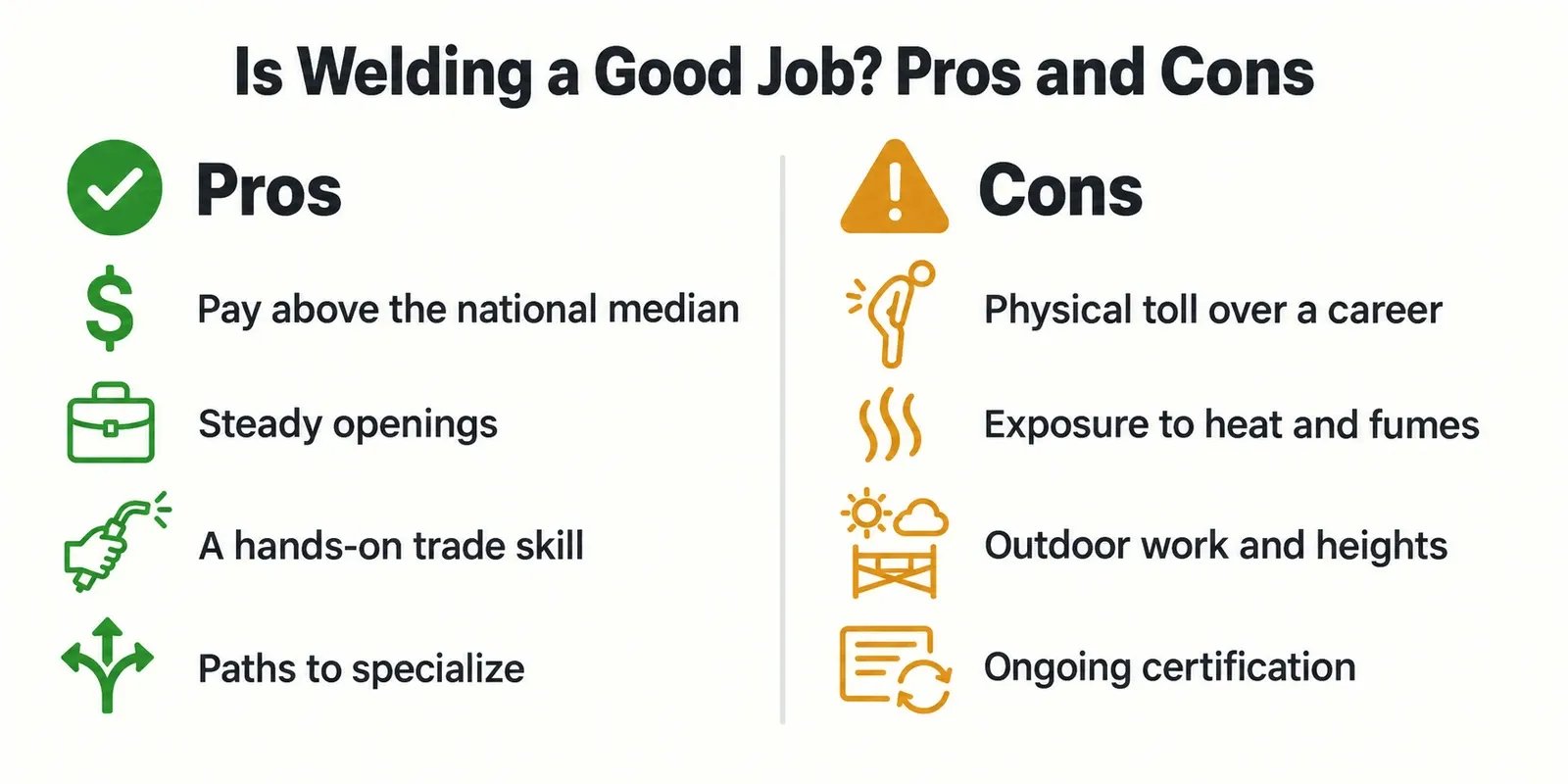
- Pay above the national median without a four-year degree. The May 2025 median for welders, cutters, solderers, and brazers was $53,750, or $25.84 an hour, and the highest 10 percent earned more than $77,530.
- Steady openings. BLS projects about 40,300 openings each year through 2035, even with slow overall growth.
- A hands-on trade skill. The result of each shift is physical and visible, and the skill transfers across manufacturing, construction, and repair employers.
- Paths to specialize. Specialties include pipeline, underwater, and aerospace welding. BLS states that wages vary with experience and skill level, the industry, and the size of the company.
Cons
- Physical toll over a career. Years of lifting, kneeling, and overhead work add up.
- Exposure to heat and fumes. Protective equipment and safety procedures lower the risk, and they have to be used every shift.
- Outdoor work and heights in some jobs. BLS notes that welders may work outdoors in all types of weather, or on a scaffold or platform high off the ground.
- Ongoing certification. An AWS Certified Welder credential stays active only when maintenance paperwork is submitted every six months, and specialized work can call for additional tests.
What Is the Job Outlook for Welders?
What is the job outlook for a welder entering the trade now? Slow growth with a steady flow of openings. The Bureau of Labor Statistics projects employment of welders, cutters, solderers, and brazers to grow 2 percent from 2025 to 2035, which it rates as slower than the average for all occupations. That works out to about 10,300 added jobs on a base of 437,700.
Growth is not the same as hiring. BLS projects about 40,300 openings each year, on average, over the decade. It expects most of those openings to come from the need to replace workers who transfer to other occupations or leave the labor force, such as to retire.
Two forces pull in opposite directions. BLS points to the nation's aging infrastructure, where welders will be needed to help rebuild bridges, highways, and buildings, and to manufacturing plants that produce metal products and machinery. It also cautions that automation in manufacturing may limit overall demand. Manufacturing holds 63 percent of the jobs, so that caution carries weight.
How to Get a Welding Job
The path to a first welding job runs through training, a credential, and a practical test. BLS reports that employers often prefer or require a high school diploma or equivalent plus technical training, and that some hire entry-level workers and train them on the job.
- Complete a welding program or apprenticeship. Training is available through high school technical classes, vocational-technical institutes, community colleges, and private welding schools, and the U.S. Armed Forces offer welding-related training. Some employer-based apprenticeships accept beginners with no experience. Program length varies by school and by credential. Dreambound is a marketplace where students compare trade programs, welding schools included.
- Earn a certification. The American Welding Society's Certified Welder program has no education or experience prerequisites. Candidates complete a weld to a written procedure at an AWS Accredited Test Facility, and a Certified Welding Inspector evaluates it. Fees vary by test facility. BLS notes that some employers require certification for particular jobs, and that welders must be licensed in some states and localities.
- Build a record of your work. Keep photos of practice welds, bend test results, and certification paperwork from your program, so an employer can see the processes and positions you have practiced.
- Prepare for a hands-on weld test. Employers may ask candidates to complete a test weld during hiring, including candidates who already hold a certificate. Practice the process and position named in the job posting beforehand.
Southern Careers Institute is one school with a Welding program listed on Dreambound. The program runs 27 weeks (700 clock hours) and is listed for four Texas campuses: Austin, San Antonio North, Corpus Christi, and Harlingen. The format differs by campus, and each program page shows it.
Skills and Qualities Needed to Succeed as a Welder
BLS names five qualities as important for this occupation, and the daily duties add a sixth.
- Detail orientation. Welders perform precision work and must detect changes in molten metal flow.
- Manual dexterity. A steady hand holds the torch in place, supported by good hand-eye coordination.
- Physical stamina. The work involves holding awkward positions for long periods.
- Physical strength. Welders lift heavy pieces of metal and move equipment.
- Spatial orientation. Two- and three-dimensional diagrams have to be read and translated into the part.
- Blueprint reading. Interpreting blueprints, sketches, and specifications is a listed duty, and BLS notes that courses in blueprint reading, shop mathematics, and mechanical drawing may be helpful.
The work also calls for patience with repetitive, precise tasks, sometimes in uncomfortable conditions.